Dynamic project sites across Central Florida require mobile sanitation that shifts forward as crews advance. A trailer-mounted mobile toilet fastens a heavy-duty 60-gallon holding tank restroom to an integrated steel…
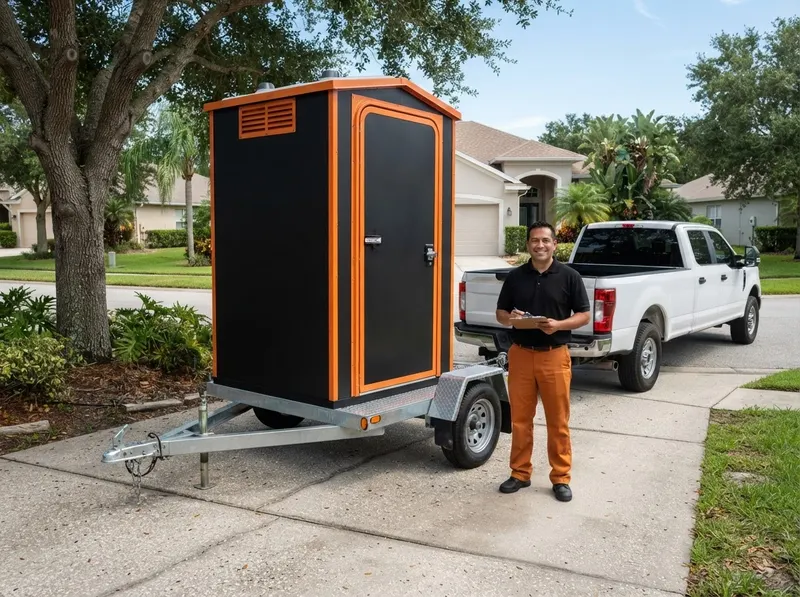
Dynamic project sites across Central Florida require mobile sanitation that shifts forward as crews advance. A trailer-mounted mobile toilet fastens a heavy-duty 60-gallon holding tank restroom to an integrated steel trailer frame, bypassing the delays of scheduling forklift or tilt-bed crane moves every time work relocates 500 feet down the road. For road surfacing along the SODO District or linear underground conduit installation near MetroWest, standard skid-mounted units remain static and trigger downtime while workers walk long distances. The trailer-mounted alternative stays attached to a work truck or rests securely on dual drop-leg stabilizers, permitting foremen to re-hitch and reposition the station across the work zone in under 5 minutes without calling dispatch.
Selecting mobile trailer gear introduces specific operational considerations. While a skid unit sits flush on bare soil, a trailer unit requires a clear, level 8-foot by 12-foot operational footprint and stable ground for the trailer tongue and stabilizing jacks. For residential remodeling projects tight against curbs in Lake Eola Heights, College Park, or Thornton Park, street parking regulations require adherence to municipal right-of-way guidelines, and tongue locks become essential to prevent uncoupling on public asphalt. Central Florida's humid climate also accelerates tank activity: units deployed under full sun on asphalt corridors along Baldwin Park or Delaney Park utilize concentrated biocide treatments to maintain odor control between weekly service stops.
OSHA standard 29 CFR 1926.51 mandates accessible operational toilets based on crew headcount, establishing that sanitation must stay readily reachable to avoid costly job-site safety citations. On fast-paced commercial utility installations near Lake Nona and Audubon Park, shifting work zones make permanent plumbed or static units impractical. Choosing a mobile trailer configuration requires balancing vehicle towing capacity, typically requiring a Class III hitch with a 3,500-pound rating, against the cost of static unit relocation fees, eliminating carrier crane charges while keeping working crews compliant and productive throughout the project lifecycle.
Every job gets a firm, written price after a free on-site visit.
Tell us about your trailer-mounted mobile toilet job in Orlando and we'll send a clear, written quote, usually the same day.
 Bison Portable Toilets